
What’s Wrong with Land Acknowledgments?
As part of Canada’s national program of reconciliation with its first nations peoples, a ‘land acknowledgment’ is frequently read out at public events. The names of the First Nations people (Cree, Ojibwa, Algonquin, etc.) who lived here prior to the European settlement are recognized. A sentence or two is frequently added at the end seeking reconciliation and a wish for peace and tolerance.
It’s a nice gesture. However, when I hear these acknowledgments, I can’t help but feel that only part of the story is being conveyed. The named tribes are not ‘original inhabitants’ in the sense that they had always been here prior to European settlement. The fact is that pre-contact indigenous history was replete with patterns of armed conflict, displacement, and absorption. Tribes frequently migrated across the continent coming into contact with other tribes. Sometimes these contacts would be friendly and result in trade, cultural exchange and and mutual tolerance. But just as frequently, these contacts would result in a bloody contest of dominance. It may take centuries, but eventually one tribe would prevail and the other would be violently eliminated or at least absorbed into the winner. The inhabitants of any particular place were dispossessed and replaced again and again.
My point is that words of reconciliation in land acknowledgments are welcome but the 500-year old European colonial settlement of North America was just the latest in a long string of extinctions of local peoples. The acknowledgments omit the previous hundreds and thousands of years of displacement and injustices suffered by locals at the hands of rapacious rivals.
I was here first, so get off my land!
In fact inter-group conflict and conquest is the norm anywhere you look around our planet. One view of human history is that it is largely a tale about ‘stronger’ peoples competing with, defeating, displacing or absorbing ‘weaker’ peoples. Layer upon layer, century upon century…
An even more poignant example of continual inter-tribe conflict can be seen in the much longer settled and much more disputed land of Israel – a place at the cross-roads of Asia, Africa and Europe. Each of the parties in the current conflict frequently cite their historical primacy to the land. This line of argumentation may be useful as political speaking points, but it is historical myopia to choose arbitrary points in history at which to begin your people’s narrative.
So, in the spirit of illuminating a more complete picture of the layered history of the peoples of the Levant, here is an imagined land acknowledgment delivered to a modern-day Israeli audience by the general manager of a theater prior to the start of a play:
Looking Back One Millennia
Good evening. Before we start tonight’s theatrical performance, we must acknowledge that we are situated on the land of the British Mandate of Palestine, established in 1922 at the behest of the League of Nations. The British took control here, imposing their rules, culture, parliamentary system (and much else) upon this region. But before their 25-year control of this area, the British first had to defeat the Ottoman Empire who reigned for 400 years over this, their ‘Syrian Province’, from their royal seat in Anatolia. The Ottoman empire wrested control of this land in 1517 from the Islamic state of the Mamluk Sultanate who originated in what is now Egypt. The militaristic Mamluks in turn controlled vast swaths of the eastern Mediterranean during their 300-year empire.
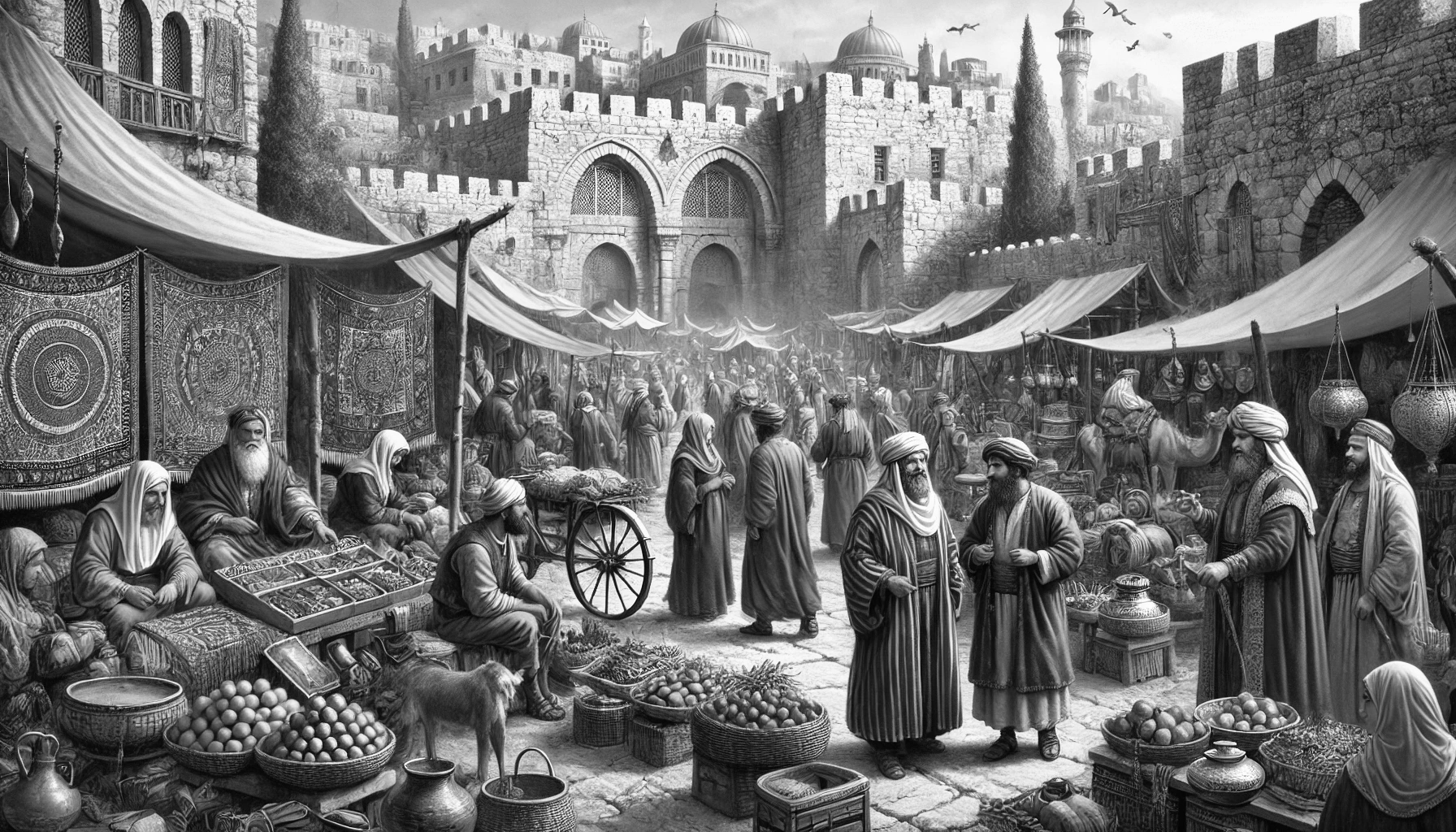
And before the Mamluks came here in the mid-13th century, we must recognize that we are standing on the ground of the peoples and tribes of the Ayyubid Arab-Kurdish Empire. Ayyubid Sultanate, was the founding dynasty of the medieval Sultanate of Egypt established in 1171 by the famous warlord Saladin.
And before the Mamluks, this was the newly ‘liberated’ lands of the Christian Kingdom of Jerusalem, as ordered by Pope Eugene III and implemented by Crusader knights. It lasted for nearly two hundred years, from the accession of Godfrey of Bouillon in 1099 until the fall of Acre in 1291. This crusade brought thousands of Christians soldiers and settlers to the land and forced conversion of thousands of the existing population.
Looking Back Two Millennia
And before this Christian kingdom, this land was the home of the Umayyad, Abbasid and Fatimid Caliphates. The Umayyads (661–750) were succeeded by the Abbasids (750–1258), while the Fatimids (909–1171) coexisted and ruled parts of the region. The people of these early Islamic empires defeated the Byzantines and merged it into their provincial region of Bilad al-Sham.
Prior to the Muslim conquest in 634 CE, the Byzantines had a 250 year reign over this area, flipping the dominant culture to a stern form of Christianity suppressing and converting (but never eliminating) the many settled and nomadic peoples of this area. The Byzantine empire emerged from the great Roman empire of which much has been written. In total, the Romans and their Byzantine successors, ruled these lands for 700 years, starting 60 years before the birth of Jesus and 600 years before the birth of Mohammad.

Dear audience, we also humbly recognize that our theater sits on the ancient lands of the Hasmonean Dynasty. A civil war over royal succession weakened the kingdom to the extent that the Romans intercession in 63 BCE resulted in its complete demise; the great temple in Jerusalem was burnt, its people were mostly (but not completely) enslaved and dispersed. A hundred years before this, the Hasmoneans were the rulers in this land. It was they who gave us “Hanukkah” when their Maccabian zealots butchered and defeated the Seleucids who, along with their Ptolemaic ancestors, were the descendants of the generals of Alexander the Great (a Macedonian conqueror of this chunk of land among many others). Alexander’s generals took control and established various kingdoms in the Levant, bringing a host of settlers from other conquered lands and mandating that the then residents of this land adopt their Hellenistic culture and their gods.

It should be remembered that, when Alexander the Great and his bronze-clad armies poured over the Hellespont, it was to ostensibly vanquish the Persian Empire, their long-time rivals. Among other possessions, the Persians held this land for about 200 years starting in about 538 BCE. When the Persians won this place (defeating the civil-war weekend Kingdoms of Israel and Judah — from which we get our name “Jews”), they brought settlers, their religion and their rich Babylonian culture to the area. The Kingdoms of Israel and Judah started strong under the reign of King Saul, David and Solomon but grew weak through civil wars and conflicts with their neighbors.
Looking Back Three Millennia
And we acknowledge that before the ancient kingdoms of Israel and Judah emerged under their royal dynasties, here dwelt the people of the theocracy of the twelve tribes of Israel, notionally allied but in fact each laying claim to each other’s territory, fighting off outsiders and jockeying for control of different parts of this land. In the chapter Exodus, the bible tells us that these tribes of Israelites emerged victorious after a miracle-sprinkled slave revolt in Egypt ending hundreds of years of exile from their homeland. The historical accuracy of this story cannot be established but is generally considered ‘mythologized history’ by modern-day scholars.
The Israelite tribes wandered for decades (we are told) sweeping through the eastern Mediterranean, defeating the various tribes and peoples of the Egyptian New Kingdom who had held the region for centuries before that. They settled here, in their ‘promised land’.
Hundreds of years prior to the Israelite Exodus and conquest over the eastern-Mediterranean branch of Egyptian civilization, war, disease, starvation, and slavery followed when the great pharaohs of Egypt deployed their armies to defeat the independent mini-states of Canaanite city-kingdoms and came to dominate these lands. This conquest started in about 1550 BCE and ended up with the Canaanite city states as semi-independent vassals to the New Kingdom of Egypt. This was the time of the bronze age where written history is limited to a few surviving cuneiform tablets, engravings on tombs and miscellaneous evidence from archaeological digs.

Looking Back Even Further
Things get a bit fuzzy at this point in our acknowledgment of the peoples who dwelt in this land. There is archaeological evidence that the Canaanite war lords and their city-states grew out of 3,000 year old, early bronze-age habitations that were peppered all over the Levant. Here we take a giant leap as we note that there is at least another million years of prehistorical habitation in this region that we can piece together from the archaeological record. The earliest human remains in the region are about 1.5 million years old; found a few kilometers south of the Sea of Galilee. Arrow-heads and axes of different eras litter our holy ground and the graves under them are full of broken skulls.
In Closing
So, in closing, we humbly acknowledge the ‘original’ inhabitants of this land and the suffering they endured during the many violent conquests that swept the Levant. And we note that, while we can claim that our ancestors have lived here for millennia, we are realistic enough to admit that we are merely the latest custodians of this beautiful land of milk and honey.
Enjoy the play!


 Riesenbach.com
Leave a comment