
This narrative of our September 2000 mission to Poland is in Joe’s own words, recorded and edited by his wife Ruth, digitized and illuminated by his son, Ron.
Introduction
I never intended to revisit Poland after arriving in Canada. My war experiences and memories of the attitude of the Polish People before and after liberation were not pleasant ones. For years the thought of revisiting never entered my mind until several circumstances entered into my life. Firstly, I and my wife sponsored a visit of a Polish young man, named Wacek. He is the grandson of Janina Czarnota. Janina was the daughter of Julia and Joseph Bar, the couple who took me and my parents and two sisters into their home, and hid us there for over two years, in the attic of their tiny farm house. The daughter, Janina, was a very young girl of 18-at the time, and it was she who did the most work in providing us with the little food they could spare.
Janina is now seventy-seven years old, a grandmother to seven grandchildren and four great-grandchildren. When we offered to sponsor her to come here to visit us, she declined due to health reasons, and asked instead that we invite one of her grandchildren. As a result, Wacek was chosen, and he stayed with us for two months the first time. Two years later he asked to come again, and this time he stayed for a year. Needless to say, his visit brought back many memories, and in conversations with him, I began to develop the seeds of a possible return. But that did not germinate till a visit by my niece Cindy (who lives in Toronto), decided to rediscover her roots by talking a trip to our little village of Markowa and visiting with Janina and her family. Upon her return, she regaled me with stories of the village and the family she saw there. She urged me to consider visiting, mainly for the sake of Janina, who expressed her hope to see me and my sisters; once more before she dies. Shortly after this, we discovered relatives in Argentina, who had traced me through the archives at the Washington Holocaust Museum. The son of my cousin, Gabriel Anmuth, encouraged me to join him and his parents in retracing the background of their father and grandfather who had emigrated from Markowa to Argentina in the early 30’s. This person was my mother’s cousin, with whom she had been in correspondence shortly after arriving in Canada. The pressures of all these stimuli, together with my son, Ron, who was eager to accompany me, finally convinced me to make the decision to plan the trip.
September 19, 2000: Warsaw
As prearranged, we all met in Warsaw on September 18, 2000. The next day, we went on a walking tour with an English/Spanish Speaking Guide. We visited the memorials to the Warsaw Ghetto, including the last boulder from the building at Mila 18, where the heroes of the ghetto made their last stand against the Nazis. Upon arrival at this memorial we encountered a group of Israeli youth, together with their leaders, carrying Israeli Flags, and standing at attention on the steps of the memorial. Suddenly we heard the strains of “Hatikvah” being sung. With tears in our eyes we joined in with them. Later we visited several former Jewish Synagogues which had been converted to museums. Also the areas from where Jews were deported to concentration camps .

The Warsaw Cemetery is approximately 20 hectare in size or 60 acres. It is an immense overgrown jungle of trees , grass and debris, with many overturned headstones. It was founded in 1799, completed 1803, with 150,000 graves, some as much as 4 layers . Many Tzadikim and monuments to holocaust victims stand there, as well as one to Janush Korczak and his children. Memorial candles line the monuments, and include a monument to the one million Jewish Children who perished in the Holocaust. This one has pictures of children encased in stone with the inscription “In Memory– of the 1 Million children who were annihilated by the Nazis”.
Video clip 1: Walking through Warsaw
Video clip 2: Mila 18 Memorial
Video clip 3: Warsaw Deportation Memorial
Video clip 4: Warsaw Cemetery
September 20, 2000: Train to Krakow
The next day we took a train to Krakow. We stayed in a hotel called “Ester” in the former Jewish quarter called “Kasmierz”.

September 21: Krakow
In Krakow we visited several synagogues which are also now museums , except for the Remmah Synagogue , which is the only functioning one in Krakow.
We attended Friday night and Saturday Morning services there , and again encountered a group of Israeli Girls from a Yeshiva, whose spirited singing and dancing after the service was an inspiration to all of us.
Kasmierz is now a “Jewish Tourist Trap” with several restaurants all featuring Jewish style food , pre-war decor, complete with Mezuzahs, old pictures of Jewish Life, People and families, antique furniture and lace window-coverings,-an old-world charm reminiscent of a time gone by. The menus feature: Kachke, Gefilte Fish, Kishka, Kreplach, Chulent, etc. The signs on the buildings are in Polish/Hebrew/Yiddish. Every restaurant features a Klezmer band, and for a minimal extra charge, one could have dinner in the room in which they played rousing Yiddish melodies . All the owners of the businesses, waiters, and musicians are Polish.
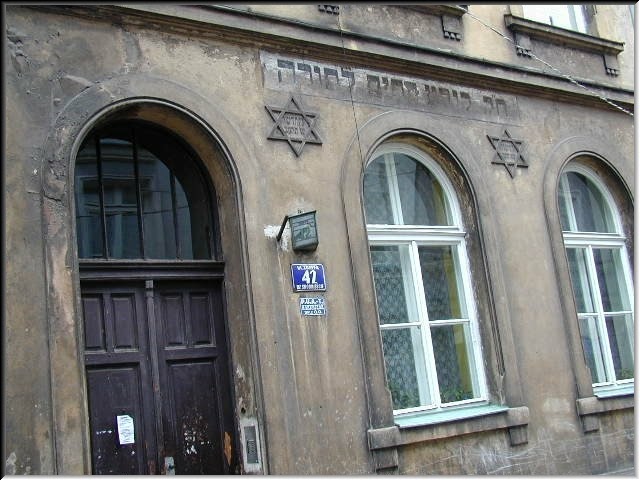
It is estimated that there are approximately 100 Jews scattered around the city, but no one knows their exact numbers. The Jewish Presence is most strongly felt in Kasmierz, where it seems the country is taking advantage of a profitable drawing-card for Jewish and non-Jewish tourists. Next to the Remah synagogue stands a 17th century cemetery , where the headstones were covered with little tin roofs to protect them from further deterioration.
We roamed around the headstones trying to identify names and dates. A long wall separates the grounds from the street , and in the wall are hundreds of pieces of headstones cemented into the wall, which were found scattered throughout the city after the war. The Germans had used headstones from Jewish Cemeteries to pave the roads, as well as Poles taking them to build houses.
Video clip: Krakow Klezmer Band
September 22, 2000: Auschwitz-Birkenau
On Friday, September 22, we all went down to the central bus station and took a bus to Auschwitz concentration camp. While there, we also visited Birkenau with a guide. What can one say about this visit!! In the words of my son, Ron, “It makes me ashamed to be called a member of the human race”.
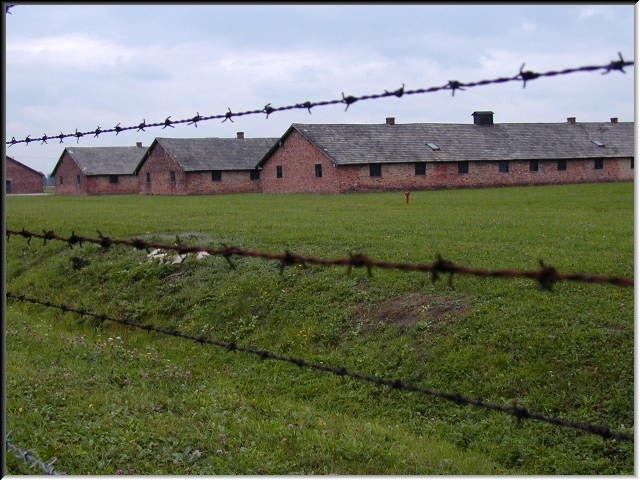
Upon our return to our hotel, we all needed a lift, and we went to a restaurant for a real Shabbas Meal. We made a toast over the kiddush wine, thanking God for the survival of our people, in spite of Hitler’s attempt to annihilate us all. While at the camps, we saw hundreds of tourists from all over the world, and were told that this goes on every day of the year.
September 23, 2000: Wieliczka Salt Mine
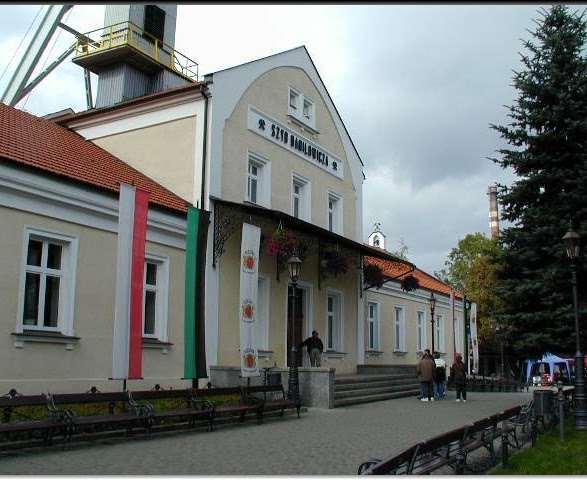
Saturday afternoon was spent at the Salt Mine in Wieliczka. That was an exceptionally interesting experience.
September 24, 2000: Reunion in Markowa
Sunday, September 24, a van picked us up at our hotel to take us on the last leg of our journey. Again we had an English/Spanish guide accompany us. We drove through beautiful countryside, with rolling hills, lush farmland, and to our surprise, many large modern-looking houses scattered over the landscape. Our first stop was Tarnow, a city which once had a thriving Jewish community. I and my family, together with a trainload of Jews had stayed here on our way out of Poland, and the city held a bitter memory for me, as a terrible incident happened here, but that story is for another time. Our guide walked us through the once Jewish area, where a sign still reads “Uliza Zydowska” – Die Yiddishe Gass. The former synagogue was destroyed by the Germans on November 1, 1939. A plaque stands where the alter once stood commemorating the event. All that is left of the synagogue is four pillars which were once part of the Bimah. A roof covers the pillars to protect them from further decay. A world-restoration organization renovates former Jewish sites, and they renovated the original entrance gate and placed a wrought iron fence around the perimeter. Various Jewish Organizations, such as the Ronald Lauder Foundation continue to restore Jewish Relics all over Europe.
The next stop was Rszeszow, the first transit place I, and my family stayed after being chased out of our home in Markowa after 1945. At that time, one building was designated for Jewish survivors from all over the region. An Israeli Shaliach was supposed to accompany us on our trek through Poland on our way to Austria. We were there only a few days when a Pogrom was staged by the Polish Authorities. Thanks to Russian Soldiers who were in the vicinity at the time, and were notified of our peril, we were rescued and escorted out of the city. The city brought back, bitter memories of that day as I tried to locate the building in which we stayed, but I was unable to pinpoint the exact location. The two synagogues in Rszeszow are now government offices and art museums. Incidentally, everywhere we went, an entrance fee was charged to have the doors open for us to visit. Wacek met us in Rszezow . and acted as our guide for the rest of the way to my hometown.
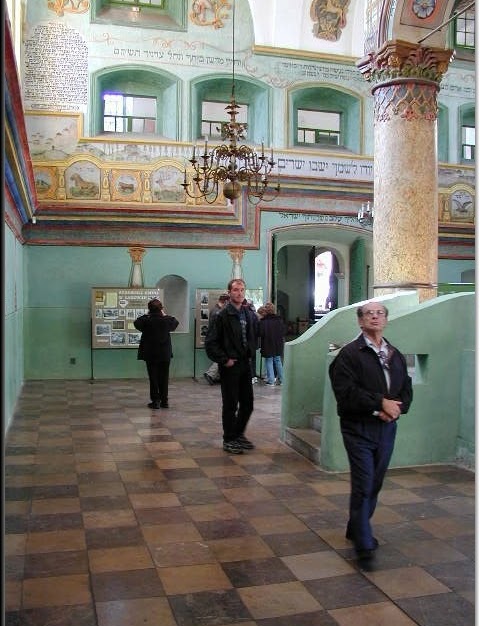
Lancut, 7 km. from Markowa, where I often came with my mother to the market, contains the famous Palace of Count Potocki . At one time his land bordered ours, and his palace is now a museum. The Lancut Distillery, operating since 1784, was once owned by Jews, and is now run by Poles who paid to have the synagogue renovated. It is a showpiece of beautiful arches, columns, artwork and prayers on the walls , with a display of pictures of the original members of the congregation, and scenes from the way it looked before the war. However, the cemetery was a disappointment. Only one tombstone remains, with overgrown grass enveloping the graves. Two buildings still remain standing on the grounds which housed the “Kehela Kadisha” and have been refurbished as mini-museums with plaques and dedications.
Driving further, we passed Nienadowka, a small village where one of my mother’s sisters once lived. Next was Sokolow, which once had two cemeteries, one of which my grandfather was buried in. Only the oldest one remains with 350 tombstones still intact, surrounded with a wire fence, under which we all crawled to get in. The second cemetery was destroyed by the Germans. I searched for my grandfather’s name but could not find it.
On the way to Markowa, we stopped at the Catholic Cemetery to pay our respects to the graves of Julia and Joseph Bar, who were the couple who if not for them, I and my family would not be here today. Approaching the street on which our house stood, I could not recognize the area. All new houses had been built on the open land surrounding the house, and the house itself had been completely rebuilt , making it unrecognizable. If not for the curves in the road leading to my former home, which I vividly remembered, I would not have recognized it as my birthplace.
We knew that our guide, Wacek, was uncomfortable in making our presence obvious, we did not linger long here, and continued on to his family’s home to meet Janina and her family.
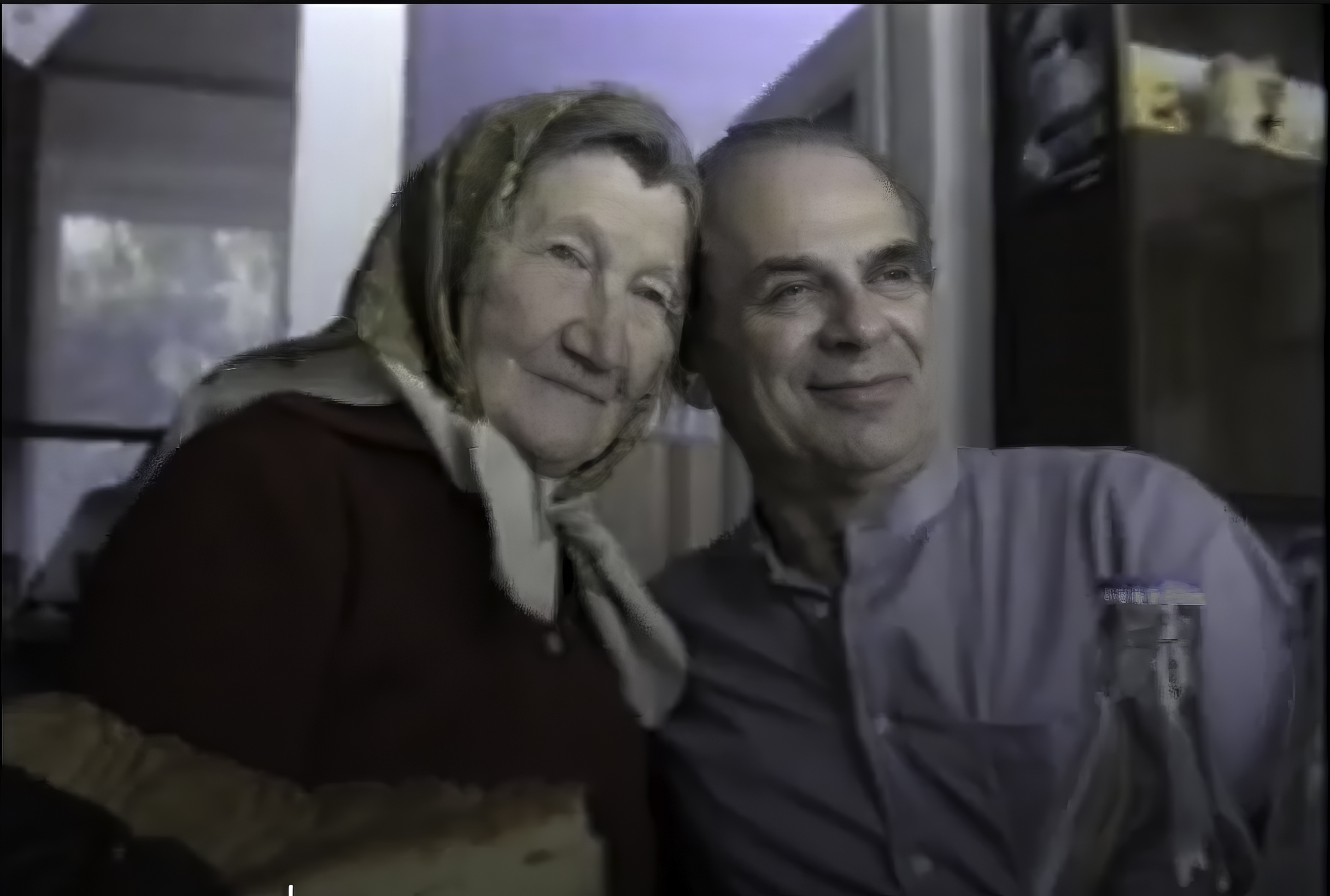

We were a total of 9 people in our party, and the reception we received there, was overwhelming. Wacek’s mother, Maria, Janina’s daughter, prepared a table fit for a king. All kinds of food and pastries were laid out on the table, and the meeting with all of them was emotional.
As one would imagine, seeing Janina face to face was the most exciting and heart-wrenching experience for me, . and only a little less so for my wife and son. Although I hadn’t used the Polish Language in years, it came flooding back to me as though I had only recently stopped using it, and I was able to converse quite fluently. My reunion with Janina was everything I could have hoped for. We reminisced about the terrible years that we were a “guest” in her home. She told me incidents that occurred then that I wasn’t even aware of.
Being a Sunday, the whole family was able to come see us – the two married sons with their wives and children , and the single brother and sisters. They didn’t stop plying us with food and wonderful conversation. We spent several hours with them that afternoon and by evening we returned to our hotel in Rzeszow.
Video clip 1: The Drive
Video clip 2: Wacek
Video clip 3: The Reunion
Video clip 4: More Reunion
Video clip 5: A Toast
September 25, 2000: Lancut and Markowa Farewell
The next morning Wacek came to meet us and accompanied us as we continued on our quest. One of our objectives was to see if we could find information in the archives, of our families. The cousin from Argentina, Gabriel, was eager to find evidence of his grandfather who emigrated to Argentina. After several leads, we found a wealth of information in the archives in Kantchuga, a small town eleven kilometers from Markowa. Our official guide promised to follow-up on this and will be in touch with us.
Late in the afternoon we returned to Jannina house, a lavish table was again set for us. We stayed till evening, as we had a 2 1/2 hour drive back to Krakow. As before, our visit was heartwarming and satisfying. We explored the barn and hay loft, animals and garage. Seeing the hay in the rafters, and the store of potatoes in the root cellar of the barn, a flood of memories returned to me, of the time we spent under the thatched roof of the Bar House, where we lay in the hay for over two years, with only an occasional respite to the living-room. On several occasions, when danger lurked, we hid in a bunker covered up with potatoes, much like the one they had in their barn.
Then came the moment to say our good-byes , a moment I was dreading. How could I part with Janina, both of us knowing that we would probably never see each other again? The only thing I could do was promise her I would try to return. Perhaps one day! Upon leaving they presented us with shopping bags full of gifts, souvenirs which we will always treasure.

September 26, 2000: Traveling Home
We returned to Krakow for an overnight stay and left the next morning for Warsaw where we again explored the old city. The next morning all of us had different flights back home and so we parted with our newly found relatives.

It is thanks to them for encouraging me to make this pilgrimage, as well as my son, Ron. Being surrounded with relatives, cousins, son, wife, helped to alleviate my trepidation, and gave me the strength to meet the challenge of going back to a land that held such unhappy memories. I don’t regret having done so, and feel that I have made a closure. There is no resemblance now, in Markowa, to the village as I remember it. I felt no attachment to the country or surroundings as I passed through the areas I remembered from my youth. It was good to return to the safety of my home here in Canada!
Photos and Videos of the Mission
Click here for all 393 photos of the trip.
Click here to watch the full video of the trip:
DVD 1: Sep18-Arrival, Sep19-Warsaw, Sep21-Krakow, Sep22-Auschwitz
DVD 2: Sep20-Train to Krakow (Joe retells the story of the survival of the Riesenbach family)
DVD 3: Sep23-Salt Mine, Sep 24-Tarnow, Lancut, Markowa
DVD 4: Sep25-Markowa, Sep26-Back to Warsaw
Canadian Jewish News:
Survivor meets woman who saved his family
December 14, 2000
By PAUL LUNGEN
Staff Reporter
TORONTO – For two-year and five days in 1943 and 1944, the Riesenbach family’s world consisted of a tiny attic in a farmer’s barn, or, when danger was particularly acute, a coffin-like space under a mound of potatoes in a cold cellar.
Five members of the Riesenbach family lived in those cramped spaces, subsisting on a paltry diet of boiled potatoes as their muscles atrophied from lack of use.
The, Riesenbachs never forgot Josef and Julia Bar and their teenaged daughter Janina, the Polish Catholic family who risked their lives to save them from the Nazis and their local collaborators.
When Soviet forces pushed the Germans out of their Silesian village of Markowa, the Riesenbachs received a new lease on life.
Joe Riesenbach made a new life for I himself in Winnipeg, but he kept contact with the Bars, sending them parcels of clothing, food and “luxury” items they could not get in Communist Poland.
When he retired a few years ago, Joe offered to bring Janina to Canada for a visit. Citing her age, she declined. Instead, she sent her grandson, Wacek Balawejder, who twice visited the Riesenbachs in Winnipeg and Joe’s sister, Genny Wasser, in Toronto. He spent a total of 14 months here.
Cindy Wasser, Joe’s niece, reciprocated that visit, traveling to Markowa about a year ago. She met Janina and relayed a message “that it was her fondest wish to see Joe and his sisters before she died.
Still, Joe was hesitant. “I had no interest to return to Poland. I have bad memories” he said.
In June 1999, however, he received a I letter from the Holocaust Museum in Washington, to which he had given memento’s of his families past. A family from Argentina visiting the museum recognized a post-war Shanah Tovah that featured a photo of the Riesenbach family[i].
Gabriel Anmuth, a civil engineer in Bahia Blanca, had seen the same postcard among his late father’s letters and photos. It turned out that his late father, Netalio, was a distant cousin of the Riesenbachs[ii].
In January, the Riesenbachs met Gabriel and his wife Marisa, a Hebrew school teacher, in Miami. They talked about their family histories.
Gabriel “wanted to visit Poland to see the roots where his grandfather came from,” Joe said. Joe’s son, Ron, was ready to join the Anmuths and so Joe signed on as well. In-October, Joe, his wife Ruth, Ron and the Anmuths made the trip.
They visited Warsaw, where they were intensely moved by the memorials in the city’s former Jewish ghetto. They took a train in Cracow, where Polish Catholics are reviving the city’s once vibrant Jewish culture. And they visited Auschwitz-Birkenau, only a short distance away.
In Cracow, they were met by a driver and interpreter arranged by Shtetl Shleppers, a Texas-based non-profit organization that organizes custom tour s of Eastern Europe.
Heading to Markowa, Joe was a little apprehensive, but “I felt good because I had part of my family with me. As I approached the Village, I knew it wouldn’t be the same. His family home had been renovated and appropriated by the local municipality. Some of the old Jewish cemeteries were gone and even the barn where they, were hidden had been torn down[iii].
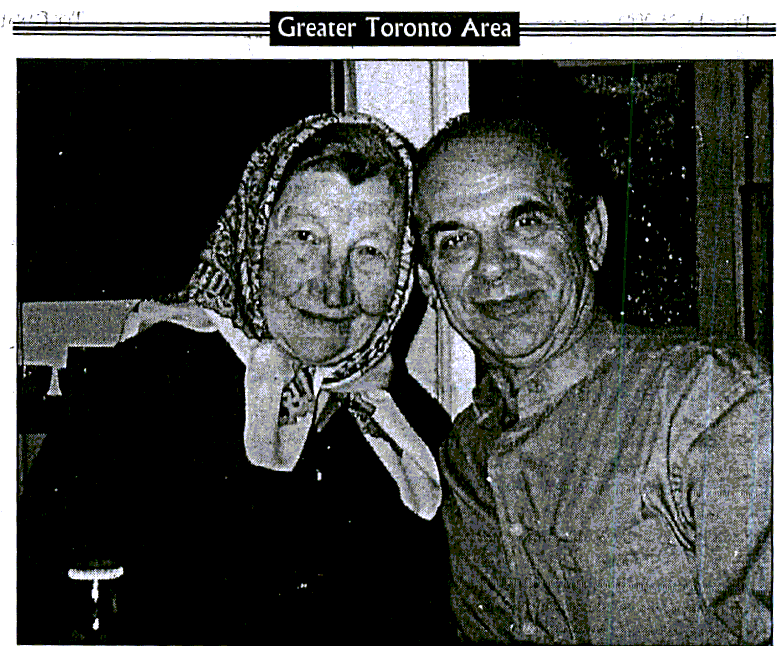
But waiting for them in front of their house were Janina Bar and her family, children and grandchildren, about.15 people in all. Joe and Janina embraced immediately and their emotions spilled over.
“Once I came there, they couldn’t tear us apart. The tears came, of course. I tried to toughen up;” he said.
The Bars invited them into their-home and the families talked and talked. Food was piled ‘high on the table and there was plenty of vodka and wine to fortify them.
“Janina said she loved my mother. They were like sisters:’ Joe said.
Janina recounted an occasion when the Riesenbachs were nearly caught. One Sunday, when the local priest spoke from the pulpit and told his parishioners that two Jewish families were still. unaccounted for, he urged them to leave the church and do a house to house search to find them[iv].
Josef Bar rushed home immediately and moved the Riesenbachs from the barn’s attic to a space he had constructed for them under a pile of potatoes. Even though local villagers searched the cellar, their hiding place was not found.
“If the Nazi had found us out, they [the Bars] would have been executed on the spot,” Joe said. “It happened. It happened in the village. Thirteen Poles [including children] and seven or eight Jews were executed in the same village.”
While many in the village were inclined to hunt down Jews, it was the Bars’ deep religious faith that saved the Riesenbachs.
“Janina’s mother, Julia, was a true Christian. She believed in fate, that if God sent these people to them, it was God’s will dial she help them” Joe said.
Many others in the village didn’t see it that way – and still don’t. The Bars’ wartime exploits remain a closely guarded family secret in Markowa for fear of attack by antiSemitic neighbours. When Wacek accompanied their Jewish visitors outside the home, he shied away from them and turned his back so neighbours wouldn’t conclude he was with them, Ruth said. The Bars “told us not to attract attention,” she added.
Still, for the Riesenbachs and Anmuths, the visit was an experience to be cherished.
“Ron called it a highlight of his life. You come back changed,” said Ron’s wife, Perla.
“It was definitely worthwhile,” Joe said. “It was very fulfilling.”
Details of the trip can be found at www.riesenbach.com.
Footnotes by Ron Riesenbach
[i] In fact, Gabriel conducted a last-name search for “Riesenbach” and came up with Joe’s name. The photo was something that Gabi had found in his grandfathers belongings in Argentina.
[ii] Natalio is very much alive and well. It is Gabriel’s Grandfather (Natalio’s father) that passed away.
[iii] In fact, Markowa was too small to have a Jewish Cemetary of it’s own. The neighboring villages of Kancuga and the town of Lancut had Jewish Cemeteries.
[iv][iv] There is some dispute about the role of the priest in this round-up. At the meeting in Markowa, Janina denied that the priest had said anything.
 Riesenbach.com