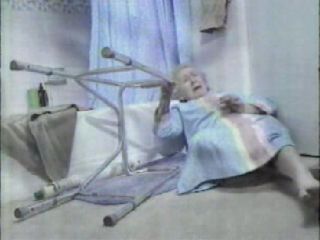
One of a handful of memorable ideas that I picked up through my MBA is that consumers are driven by two key motivators: fear and greed. While a bit pessimistic about the human condition, I have found that this simple model explains a large percentage of the economic behavior of consumers in the western world.

Click on image above for campy video clip
The latest example of the application of the fear/greed model came early this week, when I and a small number of folks from OTN had a half-day visit to firm that specialized in the emergency response for the elderly. Learning how to grow and professionalize OTN’s technical services is a priority for me and my managers. In the interest of learning how others have made this transition, this visit was organized by our Director of HR who use to work for this firm. I won’t mention the name of the firm (let’s call them CantGetUp), but the Canadian headquarters is located only a couple of kilometers from OTN’s shiny new Toronto office. It was an educational and thought-provoking meeting/tour and I left with my head spinning with ideas.
Personal Help Button
Some background… CantGetUp was originally a North American firm but it was recently bought by a European healthcare giant. Their business model is refreshingly simple. CantGetUp provides subscribers (typically seniors living at home or in retirement residences) an easy-to-use personal response service that lets them summon help any time of the day or night. There are a number of devices they deploy in the home, but the showcase one is a call-button designed to look like a piece of jewelry. The “Personal Help Button” is worn on a wristband or pendant. When pressed, the call button communicates wirelessly to a base-station that is connected to the subscriber’s home phone. A message goes out the phone-lines to one of two Response Centres (Toronto and Montreal). The answering agent then responds in a number of ways including calling the subscriber, calling a neighbor/relative or even dispatching an ambulance.The US organization has over half a million subscribers and the Canadian one about 10% of that number. CantGetUp has 200 employees across Canada with about 90 of them working for the Response Centre.The value proposition to the consumer is stunningly simple and the service model straightforward enough to have earned CantGetUp something like 80% of the market for this service. As for profitability, the global healthcare giant doesn’t publish the details, but the 2005 SEC filing of the US branch of the company (prior to acquisition) reported $150M in revenue and $18M in annual profit.
Millions of Alarms
One of the eye-openers was how they staffed, organized and operate their 7/24 Response Centre. These 90 folks handle 1.4 million alarms a year (!). Many day-time alarms are not emergencies (low battery, lost pendant, etc.). However, most night-time alarms are indeed emergencies. Unlike OTN’s high staff retention for technical staff, CantGetUp has something like a 40% turnover rate of Response Centre agents. Thus, they had to develop systems where all their technical and service knowledge is codified and written in formal procedures and is delivered to their agents via a comprehensive training program. They have a dedicated trainers and training centres at each facility where agents systematically go through a program of learning and mentorship to ensure they have the skills necessary for various roles. Over time, agents advance from qualification to qualification and are thus able to take on different skills-based roles.
Service Optimization
Another notable operational structure they have put in place is a Service Optimization department. This group of about 10 people focuses on process design, implementation, monitoring and mentoring. Motivated by six-sigma approaches to quality, their holistic approach to service optimization was inspirational.
Since OTN’s service offering is far more complex (technically and operationally) than that of CantGetUp, our service design will necessarily be different than theirs. However, there are many similarities between our firms where their approaches could help us. Setting aside base motivations such as fear and greed, I was glad to have an opportunity to study a firm that has made the transition from small to big and to have done it so well. This visit underlined the importance of taking the time to learn from the experiences of others as OTN grows.



 Riesenbach.com
Leave a reply to blackbird rider Cancel reply